
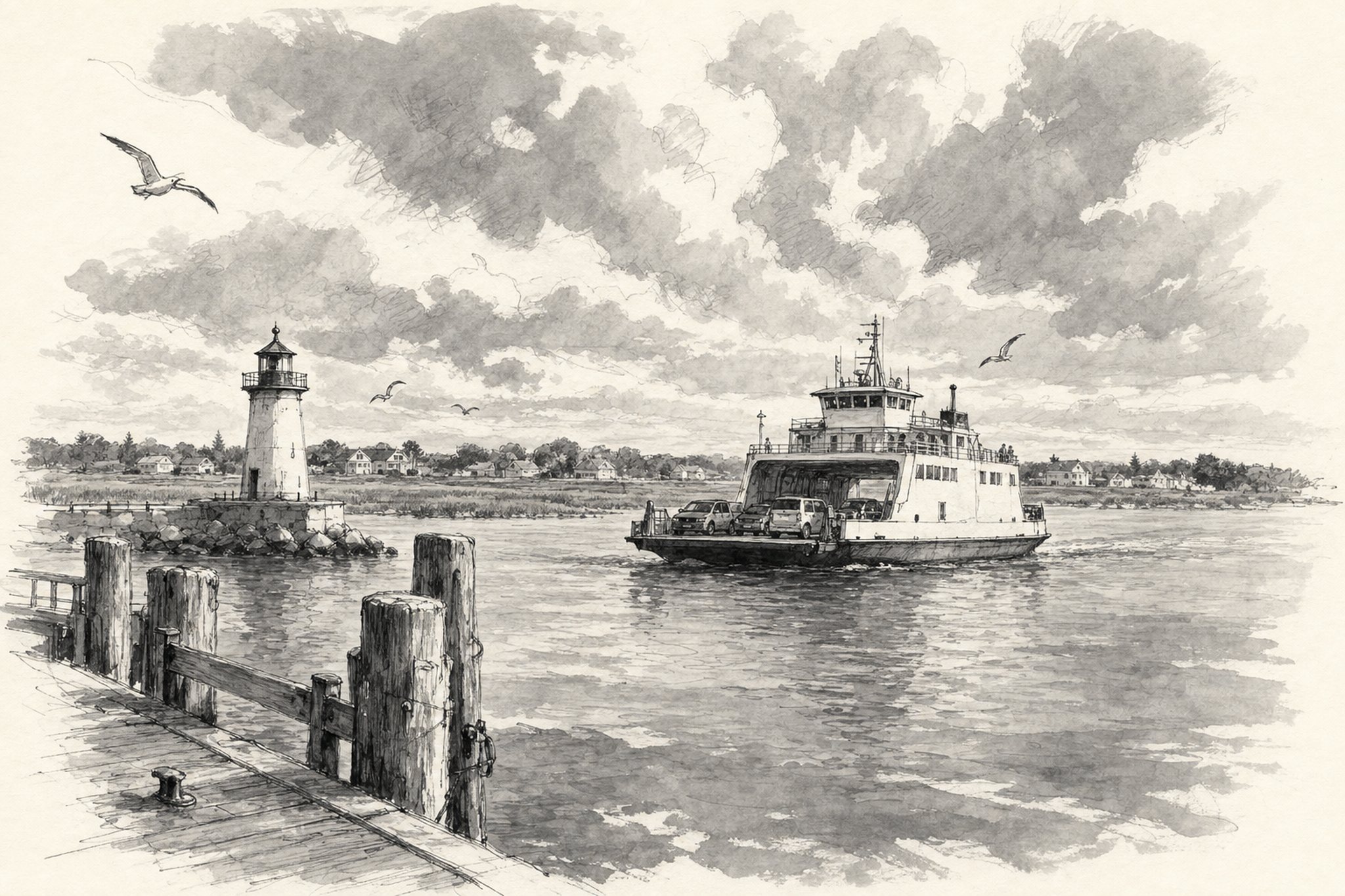
Anyone who has taken the Cape May-Lewes Ferry across Delaware Bay knows that a short trip can put you under a different set of rules. The same is true of online gambling, only the lines are drawn by state and provincial governments rather than by water. Sussex County residents live under one of the oldest regulated online casino systems in the United States, while their neighbors to the north in Canada operate under a framework that works on very different principles. Looking at the two side by side explains a good deal about why an app that is legal in one place is blocked a few hundred miles away.
Delaware’s State-Run Model
Delaware legalized online casino games through the Delaware Gaming Competitiveness Act of 2012, and in late 2013 it became the first state to offer a full suite of online casino games. It did not do this by handing out licenses to private companies. The Delaware Lottery runs the system itself, in partnership with the state’s three racetrack casinos: Delaware Park near Wilmington, and Dover Downs and Harrington Raceway in Kent County.
That arrangement has shaped the local experience. Sussex County has no casino of its own, so for residents in towns like Georgetown, Milford and Lewes, the nearest venues have long been a drive up Route 113 or Route 1. The online offering is simply an extension of those same three properties, with the lottery acting as regulator and operator at once. There is one legal market, and the state sits at the center of it.
A Patchwork Across the United States
Delaware’s approach is not typical. In the United States, each state decides for itself whether online casino games are allowed, and most still say no. Only a handful, including New Jersey, Pennsylvania, Michigan, West Virginia, Connecticut and Rhode Island, have joined Delaware in permitting them, and each uses its own licensing body and rules.
New Jersey, reachable from Lewes by ferry, shows how different the neighbouring approach can be. There, the Division of Gaming Enforcement licenses private operators tied to Atlantic City casinos, and players have a much wider choice of sites. Crossing the bay does not change what a phone can do, but geolocation software does. Online casinos in every regulated state check a player’s physical location, so a visitor from Rehoboth Beach sitting in Cape May is treated as a New Jersey player for as long as they are there.
Canada’s Provincial Approach
North of the border, the starting point is federal rather than local. Canada’s Criminal Code permits gambling only when it is “conducted and managed” by a provincial government, which is why each province built its own lottery corporation and, later, its own online casino. British Columbia, Quebec, Manitoba and Alberta all launched government-run sites, much as Delaware did.
The picture changed in April 2022, when Ontario opened a regulated market to private operators. Under that system, the Alcohol and Gaming Commission of Ontario registers and oversees companies, while iGaming Ontario, a provincial agency, contracts with them and technically conducts and manages the games on the province’s behalf. The arrangement keeps the Criminal Code requirement intact while allowing competition. Alberta has since passed legislation to follow a similar path.
The complication is that a large number of offshore sites still accept Canadian players without holding any provincial approval, so the question of which safe online casinos in Canada are worth a visitor’s time often comes down to knowing which sites are actually licensed in the province they are in. Ontario publishes its list of approved operators through iGaming Ontario, which gives players a straightforward way to check.
Why the Two Systems Diverge
The differences come down to history and constitutional structure more than to any single policy choice.
- In the United States, gambling law has traditionally been left to the states, so each legislature writes its own rules from scratch.
- In Canada, the federal Criminal Code sets the boundaries, and provinces work within them.
- Delaware chose a state-run monopoly because it already had a lottery and racinos that relied on gaming revenue.
- Ontario opened its market partly to bring grey-market play under regulation and taxation.
Both places are trying to solve the same problem, which is how to allow a popular activity while keeping it supervised. They simply began from different legal starting points, much as Sussex County’s early colonial history set its own course apart from the counties further north.
What It Means for Travelers
For Sussex County residents who travel to Canada, or Canadian visitors who spend summers on the Delaware beaches, the practical rule is simple: the laws that apply are the laws of the place where you are standing. An account opened with Delaware’s online casino will not work in Toronto, and an Ontario-registered site will not work in Bethany Beach.
That may seem inconvenient, but it reflects something familiar to anyone who knows Sussex County and its coastal towns. Local rules tend to grow out of local circumstances, and online gambling is no exception. Understanding who issues the license, and where, is the most reliable way to make sense of a market that looks the same on a screen but changes every time you cross a line on the map.